

Aerial Yoga and Vinyasa: Two Different Practices That Work Well Together
Discover how Aerial Yoga and Vinyasa complement each other through strength, mobility, balance, movement and play. Try both at Yoga Loftas in Vilnius.

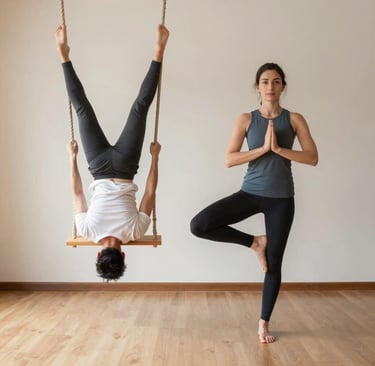
My post content
At first glance, Aerial Yoga and Vinyasa seem to belong to quite different worlds.
Vinyasa keeps you firmly connected to the floor. You support your own weight, move through sequences and develop strength, mobility and coordination through the relationship between breath and movement.
Aerial Yoga changes that relationship. The hammock can support you, destabilise you, give you something to pull against, take you upside down and sometimes simply invite you to play.
Having taught aerial yoga for many years — and now offering both Aerial and Vinyasa at Yoga Loftas — I’ve become increasingly interested in how well the two practices complement one another.
Rather than asking “Which one is better?”, a more interesting question might be:
“What does each practice give me that the other doesn’t?"
A Grounded Practice and a Suspended Practice
Vinyasa is fundamentally a grounded practice. You push into the floor, support your own body weight and move through sequences using strength, balance and coordination.
Aerial Yoga changes that relationship with gravity. The hammock can support part of your weight, make familiar movements less stable, or allow you to explore positions that would feel very different on the mat.
That contrast is one of the reasons the two practices work so well together. Vinyasa asks you to organise and control your body against the ground; aerial practice asks you to respond to an external support that can move with you.
Neither is inherently better. They simply challenge the body — and the mind — in different ways.
Push, Pull and Support
One of the most interesting differences is the type of muscular work involved.
Traditional mat-based yoga contains a lot of pushing: pressing through the hands in Downward Dog, supporting yourself in Plank, pushing through the feet in standing postures.
The aerial hammock introduces something yoga doesn’t usually give us very much of: pulling.
You can grip the fabric, pull against it, hang from it and use it to support or partially suspend the body. That adds a different kind of upper-body work and creates movement possibilities that simply aren’t available on the mat.
For someone who practises Vinyasa regularly, aerial yoga can therefore introduce a surprisingly different physical challenge. And for someone who mainly practises aerial yoga, Vinyasa provides valuable grounded, self-supported movement
Mobility, Balance and Body Awareness
Both Vinyasa and Aerial Yoga can help you explore mobility, but they often do it in quite different ways.
In Vinyasa, you usually have to create and control the movement yourself. You move your own body through space, maintain balance and organise each transition without external support.
The hammock changes that experience. Sometimes it supports part of your weight and gives you more freedom to explore a position. At other times, because the fabric itself moves, it actually makes balance and control more demanding.
That contrast can be useful. One practice asks you to stabilise against the floor; the other asks you to adapt to a support that can shift underneath or around you.
The result is a broader movement vocabulary and, often, a better sense of how your body responds in different situations.
Rhythm Versus Play
Vinyasa often develops rhythm and continuity.
As you become familiar with the practice, you begin to recognise transitions, patterns and the relationship between movement and breath. There can be something very absorbing about moving through a sequence with that sense of flow.
Aerial Yoga tends to introduce more novelty.
The hammock changes familiar movements, creates new ones and sometimes turns the practice into a small problem-solving exercise: how do I get into this position, how do I get out again, and what happens if I approach it differently?
That element of play is one of the things I value most about aerial yoga.
Adults don’t necessarily get many opportunities to experiment physically without worrying about doing something perfectly. The hammock can encourage curiosity, humour and a willingness to try.
Vinyasa can offer rhythm and refinement. Aerial Yoga can offer surprise and exploration.
Together, they make an interesting combination.
Why Practise Both?
If you enjoy Vinyasa, Aerial Yoga can introduce pulling, suspension, inversion and a different relationship with gravity.
If you mainly practise Aerial Yoga, Vinyasa can give you grounded, weight-bearing movement and the challenge of supporting and moving your own body without the hammock.
Neither needs to replace the other.
Practising both simply gives you more ways to move, more ways to challenge yourself and more ways to discover what kind of practice you enjoy.
Try Both at Yoga Loftas
You don’t have to decide whether you’re an “Aerial person” or a “Vinyasa person”.
Our new-client offer is designed to let you experiment:
3 classes for €33
Mix and match Aerial Yoga, Traditional Vinyasa, Ashtanga-inspired Vinyasa and Yang & Yin Yoga.
Take three classes in one style or combine them and see how they feel in your own body.